
- Home
- Government
- Departments
- Emergency Management
- Preparedness
- All-Hazards Preparedness Guide
All-Hazards Preparedness Guide
Being prepared to mitigate against, respond to, and recover rapidly from any threat or hazard can save lives and protect the health and safety of yourself, family, and community. Though some people feel it is impossible to be prepared for unexpected events, the truth is that taking preparedness actions helps people deal with hazards of all types much more effectively when they do occur. By reading this guide, you have taken the first step in securing your preparedness. You will learn that emergency preparedness requires attention not just to specific types of hazards but also to steps that increase preparedness for any type of hazard. The following guide and its contents have been compiled from various sources including, but not limited to:
- Active Assailant / Active Shooter
- Chemical and Hazardous Materials Incidents
- Cybersecurity
- Evacuation
- Extreme Heat
- Floods
- Older Adults
- Pandemics
- People with Disabilities
- Pets and Animals
- Shelter-In-Place
- Thunderstorms
- Tropical Storms and Hurricanes
- Tornadoes
- Wildfires
- Winter Weather
The Federal Emergency Management Agency (FEMA) defines an active assailant or active shooter as "an individual engaged in attempting to kill people in a confined space or populated area." Typically, these individuals use firearms and select victims at random. However, recent events worldwide have shown active assailants may also use vehicles, homemade improvised explosive devices (IEDs), knives, fires, and drones. Active assailant incidents can occur anywhere and at any time. Taking time to familiarize yourself with response strategies now can help you react quickly when every second counts.
Prepare Before
- If you see suspicious activity or packages, report it to local authorities as soon as possible. "If you see something, say something!"
- Familiarize yourself with emergency response plans at your school, workplace, or house of worship. If you participate in active shooter training or drills at any of these locations, share your experience with family and friends. Discuss how what you learned can be applied to other locations.
- Map out two evacuation routes and nearby exits whenever you enter a building or populated area.
- Identify places to hide including rooms without windows, behind door that lock, under desks, or behind heavy furniture.
- Sign up for active assailant, first aid, and tourniquet training.
- Federal Bureau of Investigations (FBI) Active Shooter Attack Prevention and Preparedness (ASAPP) Training Video - "Run. Hide. Fight."
- First Aid Training - American Red Cross First Aid Training or American Heart Association First Aid Training
- American College of Surgeons Tourniquet Training - "Stop the Bleed"
Survive During
When an active assailant is in your vicinity, you must be prepared both mentally and physically to deal with the situation. You have three options:
- RUN
- Have an escape route and plan in mind.
- Leave your belonging behind.
- Evacuate regardless of whether others agree to follow.
- Help others escape, if possible.
- Do not attempt to move the wounded.
- Prevent others from entering the area where the active assailant might be.
- Keep your hands visible at all times.
- Call 9-1-1 when you are safe.
- Provide the dispatcher with the following information:
- Location of the active shooter.
- Number of shooters.
- Physical description of the shooter(s).
- Number and type of weapons the assailant has.
- Number of potential victims at the location.
- Provide the dispatcher with the following information:
- HIDE
- Hide in an area out of the shooter's view.
- Cover vs. Concealment
- Cover: Anything that physically protects you from harm, especially bullets and/or other projectiles. This type of hiding is preferable as it offers protection.
- Concealment: Hides you from view but may not offer protection from projectiles. This type of hiding keeps you out of sight during an active assailant situation.
- Cover vs. Concealment
- Lock the door and/or barricade the entry to your hiding place.
- Turn off the lights.
- Silence your cell phone (including vibrate mode) and remain quiet.
- FIGHT
- As a last resort and only when your life is in imminent danger, fight.
- Attempt to disrupt and/or incapacitate the attacker.
- Act with as much physical aggression as possible.
- Use available objects as improvised weapons or throw items at the assailant.
- If possible, use teamwork and surprise. A coordinated ambush can incapacitate an attacker.
- Commit to your actions; your life depends on it.
When Law Enforcement Arrives:
The first officers to arrive on scene will not stop to help the injured. Their priority is to neutralize the threat i.e. capture, contain, or kill the active assailant. Expect rescue teams to follow initial officers. These rescue teams will remove and treat the injured. You can assist law enforcement and first responders by doing the following:
- Remain calm and follow instructions.
- Drop any items in your hands. Keep your hands empty, raised, and clearly visible at all times.
- Avoid quick movements towards officers, such as holding on to them for safety.
- Avoid pointing, screaming, and/or yelling.
- Do not stop to ask questions when evacuating.
Once you have reached a safe location, law enforcement will likely hold everyone in the area until the situation is under control. Investigators will identify and question all witnesses. Do not leave the area until law enforcement authorities have instructed you to do so.
Be Safe After
- Consider seeking professional help for you and your family to cope with the short- and long-term effects of the trauma.
A hazardous material is defined as any chemical, biological, or radiological substance/material that could adversely affect the safety of the public, handlers, or carriers during use or transportation. Hazardous materials (HAZMAT) can include explosives, flammable/combustible substances, poisons, and radiological materials.
Chemical agents are poisonous vapors, aerosols, liquids and solids that have toxic effects on people, animals or plants. Emergencies can happen during the production, storage, transportation, use or disposal of hazardous materials. You are at risk when chemicals are used unsafely or released in harmful amounts where you live, work or play.
Signs of a chemical release include difficulty breathing, eye irritation, loss of coordination, nausea or burning in the nose, throat and lungs. The presence of many dead insects or birds may indicate a chemical agent release.
Before an Incident
- Build an Emergency Supply Kit and include duct tape, scissors, and plastic to cover doors, windows, and vents.
- Make a Family Emergency Plan.
- Know how to operate your home's ventilation system.
- Identify an above-ground shelter room with as few openings as possible.
- Familiarize yourself with shelter-in-place procedures and best practices.
During an Incident
- Listen to local radio and television stations for detailed information from emergency responders and follow instructions carefully. Instructions may differ depending on the HAZMAT involved and risk of exposure. Sometimes, it may be safer to shelter in your home; other times, it may be safer to evacuate.
- If advised to evacuate:
- Evacuate immediately. To find your nearest public shelter, text SHELTER + [Your Zip Code] (Example: SHELTER 20707) to 43362.
- If you are in a building, exit the building without passing through the affected area, if possible.
- If you cannot evacuate without passing through the contaminated area, move as far away as possible and shelter-in-place.
- If instructed to stay indoors:
- Bring pets inside.
- Seek shelter in an internal room. Close and lock all exterior doors and windows. Close vents, fireplace dampers, and as many interior doors as possible. Seal the room with duct tape and plastic sheeting.
- Turn off air conditions and ventilation systems or set ventilation systems to 100 percent (100%) recirculation so that no outside air is drawn into the building.
- Seal gaps under and around the following areas with wet towels, plastic sheeting, duct tape, wax paper, and/or aluminum foil:
- Doorways and Windows
- Air Conditioning Units
- Bathroom and Kitchen Exhaust Fans
- Stove and Dryer Vents with Duct Tape and Plastic Sheeting
- Take shallow breaths through a cloth or towel if gas or vapors may have entered your location.
- Avoid eating or drinking any food or water that may be contaminated.
- If outside when the incident occurs:
- Quickly decide the fastest way to move upwind away from the contaminated area and find clean air.
- If in a car, keep the car windows and vents closed. Shut off the air conditioner or heater.
- Find the closest building to shelter-in-place.
After an Incident
- Do not leave the safety of a shelter to go outdoors or return home until authorities say it is safe to do so.
- If you or someone else are affected by the HAZMAT agent and medical help is not immediately available, the best action is to decontaminate yourself and help others to do so, if possible. The process to decontaminate is as follows:
- Remove all clothing and other items in contact with your body.
- Wash hands with soap and water. If helping someone decontaminate, immediately wash your hands and other exposed skin afterwards.
- Flush eyes with water.
- Gently wash face and hair with soap and water before thoroughly rinsing with water.
- As soon as it is safe to do so, proceed to a medical facility for screening and professional treatment.
Cyberattacks are malicious attempts to access or damage a computer or network system. These attacks can damage reputation; impact transportation and power grid; and lead to the loss of money and theft of confidential/sensitive information. Cybersecurity involves preventing, detecting, and response to cyberattacks that can have wide-ranging effects on individuals, organizations, communities, and the nation.
Mitigating Against Cyberattacks
- Limit what personal information you share online. Modify privacy settings and disable location features.
- Keep software applications and operating systems up-to-date.
- Create strong passwords by using upper/lower case letters, numbers, and special characters. Use a password manager and multi-factor authentication when possible.
- Watch for suspicious activity that asks you to do something immediately, offers something that is too good to be true, or needs your personal information. "Think before you click." When in doubt, do not click.
- Protect your home using a secure internet connection and Wi-Fi network. Change passwords regularly.
- Check your account statements and credit reports regularly.
- Be cautious about sharing personal financial information, such as your bank account number, Social Security number, or credit card number. Only share personal information on secure sites that begin with https://. Do not use sites with invalid certificates. Use a Virtual Private Network (VPN) that creates a more secure connection.
- Use antivirus, anti-malware, firewall solutions to block threats.
- Back up your files regularly in an encrypted file or encrypted file storage device.
- Do not click on links in texts or emails from people you don’t know. Scammers can create fake links to websites.
- Remember that the government will not call, text or contact you via social media about owing money.
- Keep in mind that scammers may try to take advantage of financial fears by calling with work-from-home-opportunities, debt consolidation offers, and student loan repayment plans.
If you suspect a cyberattack:
- Check your credit card and bank statements for unrecognizable charges.
- Check your credit reports for any new accounts or loans you didn’t open.
- Be alert for emails and social media users that ask for private information.
- If you notice strange activity, limit the damage by changing all of your internet account passwords immediately.
- Consider turning off the device that has been affected. Take it to a professional to scan for potential viruses and remove any that they find. Remember: A company will not call you and ask for control of your computer to fix it. This is a common scam.
- Let work, school or other system owners know what happened.
- Run a security scan on your device to make sure your system is not infected or acting more slowly or inefficiently.
- If you find a problem, disconnect your device from the Internet and perform a full system restore.
After a Cyberattack
- Report the incident to local, State, and Federal authorities.
- Contact banks, credit card companies and other financial services companies where you hold accounts. You may need to place holds on accounts that have been attacked. Close any unauthorized credit or charge accounts. Report that someone may be using your identity.
- File a report with the Office of the Inspector General (OIG) if you think someone is using your Social Security number illegally.
- File a complaint with the FBI Internet Crime Complaint Center (IC3). They will review the complaint and refer it to the appropriate agency.
- File a report with the local police so there is an official record of the incident.
- Report identity theft to the Federal Trade Commission.
- Contact the Federal Trade Commission (FTC) at ftc.gov/complaint if you receive messages from anyone claiming to be a government agent.
- Contact additional agencies depending on what information was stolen. Examples include contacting the Social Security Administration (800-269- 0271) if your Social Security number was compromised, or the Department of Motor Vehicles if your driver's license or car registration was stolen.
- Report online crime or fraud to the Internet Crime Complaint Center.
We have all heard that knowledge is power. In an emergency, it can be lifesaving. This is why we are encouraging everyone to “Be in the Know” to evacuate safely.
- Know Your Risks
- It’s important to understand your location’s risks because no two communities face the same extreme weather conditions. You can find your local risks with FEMA’s National Risk Index.
- Know When and Where to Go
- Whether it's the home of a friend or family member or a pre-designated shelter, know your evacuation destination.
- Having these plans in place can save valuable time and, most importantly, lives.
- Many states have designated evacuation zones and predetermined evacuation routes. Learn your state and local plans by visiting your state and county emergency management websites.
- Know What to Bring
- Build a go-bag with all the essentials you might need, so you don’t need to scramble in an evacuation situation. Find a list of supplies at Build A Kit.
- Make sure everyone in your household knows where the bag is stored, and who is responsible for it in the event of an emergency.
- Know Your Information Sources
- Identify where you can access reliable information so you can make informed decisions before, during, and after a disaster. Keeping up to date with the latest developments can save lives.
- Sign up for alerts from your local emergency management agencies and the National Weather Service, which will provide updates on threat conditions, shelter locations, and other important safety information.
- Download the FEMA App where you can receive real-time weather alerts, locate emergency shelters in your area, prepare for common hazards, and more.
Before an Evacuation
- Learn the types of disasters that are likely in your community and the local emergency, evacuation and shelter plans for each specific disaster.
- Plan how you will leave and where you will go if you are advised to evacuate.
- Check with local officials about what shelter spaces are available for this year.
- Identify several places you could go in an emergency such as a friend’s home in another town or a motel. Choose destinations in different directions so that you have options during an emergency.
- If needed, identify a place to stay that will accept pets. Most public shelters allow only service animals.
- Be familiar with alternate routes and other means of transportation out of your area.
- Always follow the instructions of local officials and remember that your evacuation route may be on foot depending on the type of disaster.
- Visit FEMA’s National Risk Index, an interactive tool anyone can use to improve their understanding of natural hazard risk where they live so they can take action to protect themselves.
- Come up with a family/household plan to stay in touch in case you become separated; have a meeting place and update it depending on the circumstance.
- Assemble supplies that are ready for evacuation. Prepare a “go-bag” you can carry when you evacuate on foot or public transportation and supplies for traveling longer distances if you have a car.
- If you have a car:
- Keep a full tank of gas if an evacuation seems likely. Keep a half tank of gas in it at all times in case of an unexpected need to evacuate. Gas stations may be closed during emergencies and unable to pump gas during power outages. Plan to take one car per family to reduce congestion and delay.
- Make sure you have a portable emergency kit in the car.
- If you do not have a car, plan how you will leave if needed. Decide with family, friends or your local emergency management office to see what resources may be available.
During an Evacuation
- Download the FEMA app for a list of open shelters during an active disaster in your local area.
- Listen to a battery-powered radio and follow local evacuation instructions.
- Take your emergency supply kit.
- Leave early enough to avoid being trapped by severe weather.
- Take your pets with you but understand that only service animals may be allowed in public shelters. Plan how you will care for your pets in an emergency now.
- If time allows: Call or email the out-of-state contact in your family communications plan. Tell them where you are going.
- Secure your home by closing and locking doors and windows.
- Unplug electrical equipment such as radios, televisions and small appliances. Leave freezers and refrigerators plugged in unless there is a risk of flooding. If there is damage to your home and you are instructed to do so, shut off water, gas and electricity before leaving.
- Leave a note telling others when you left and where you are going.
- Wear sturdy shoes and clothing that provides some protection such as long pants, long-sleeved shirts and a hat.
- Check with neighbors who may need a ride.
- Follow recommended evacuation routes. Do not take shortcuts, they may be blocked.
- Be alert for road hazards such as washed-out roads or bridges and downed power lines. Do not drive into flooded areas.
After an Evacuation
- If you are returning to disaster-affected areas, after significant events prepare for disruptions to daily activities and remember that returning home before storm debris is cleared is dangerous.
- Let friends and family know before you leave and when you arrive.
- Charge devices and consider getting back-up batteries in case power-outages continue.
- Fill up your gas tank and consider downloading a fuel app to check for outages along your route.
- Bring supplies such as water and non-perishable food for the car ride.
- Avoid downed power or utility lines, they may be live with deadly voltage. Stay away and report them immediately to your power or utility company.
- Only use generators outside and away from your home and NEVER run a generator inside a home or garage or connect it to your home's electrical system.
Extreme heat is a period of high heat and humidity with temperatures above 90 degrees for at least two (2) to three (3) days. Humidity increases the feeling of heat. In extreme heat, your body works extra hard to maintain a normal temperature, which can lead to death. Extreme heat is responsible for the highest number of annual deaths among all weather-related hazards. The elderly, children, and chronically ill individuals are most at risk to suffer the adverse effects of extreme heat.
Watch vs. Warning
Prepare for Extreme Heat
- Learn to recognize the signs of heat illness.
- Do not rely on a fan as your primary cooling device. Fans create air flow and a false sense of comfort, but do not reduce body temperature or prevent heat-related illnesses.
- Identify places in your community where you can go to get cool such as libraries and shopping malls or contact your local health department to find cooling options in your area.
- Cover windows with drapes or shades.
- Weather-strip doors and windows.
- Use window reflectors specifically designed to reflect heat back outside.
- Add insulation to keep the heat out.
- Use a powered attic ventilator, or attic fan, to regulate the heat level of a building’s attic by clearing out hot air.
- Install window air conditioners and insulate around them.
- If you are unable to afford your cooling costs, weatherization or energy-related home repairs, contact the Low Income Home Energy Assistance Program (LIHEAP) for help.
Stay Safe During
- Never leave people or pets in a closed car on a warm day.
- If air conditioning is not available in your home find a cooling option.
- Take cool showers or baths.
- Wear loose, lightweight, light-colored clothing.
- Use your oven less to help reduce the temperature in your home.
- If you’re outside, find shade. Wear a hat wide enough to protect your face.
- Drink plenty of fluids to stay hydrated.
- Avoid high-energy activities or work outdoors, during midday heat, if possible.
- Check on family members, older adults and neighbors.
- Watch for heat cramps, heat exhaustion and heat stroke.
- Consider pet safety. If they are outside, make sure they have plenty of cool water and access to comfortable shade. Asphalt and dark pavement can be very hot to your pet’s feet.
- Heat waves may cause you to lose power.
Flooding is the number one natural hazard in Maryland. Flooding events occur across the State from the mountains in the West to the coastal plains in the East. Weather-related events such as severe thunderstorms and tropical storms can cause river swell and storm surge. In cold weather months, freezing temperatures can result in broken pipes and water mains. Floods can occur slowly or quickly with little to no warning, especially flash floods.
Are you in a flood prone area? Do you know your flood evacuation zone? To find out, visit the Maryland Digital Flood Insurance Map Outreach Program, the FEMA Flood Map Service Center, and the Maryland Department of Emergency Management Know Your Zone websites.
Flood Watch vs. Flood Warning
Before a Flood
- Identify your flood risk.
- Move valuables to higher shelves.
- Keep storm drains clear.
- Get plastic tarps and sandbags to block floodwater.
- Be ready to shelter but identify escape routes to higher ground.
- Plan transportation to evacuate to safety, if needed.
- Plan for power outages.
- Purchase or renew a flood insurance policy.
During a Flood
- Leave immediately when evacuation orders are issued.
- Never walk through moving water. Six (6) inches of moving water can cause you to fall.
- Never drive through flood areas. One (1) foot of water can float many vehicles.
- If trapped inside, move to higher floors or roof. Call 9-1-1.
- Stay inside your car if it is trapped in rapidly moving water. Get on the roof if water is rising inside the car.
- Stay alert for mudslides.
- Dial 2-1-1 to find shelter or get assistance with resources.
After a Flood
- WAIT UNTIL OFFICIALS SAY IT IS SAFE TO GO HOME!
- Beware of damaged structures and falling trees.
- Check for gas leaks and downed power lines.
- Listen for official announcements on the safety of public water.
- Be aware of potentially hazardous materials.
- If you have flood damage, file an insurance claim and/or contact a recovery assistance agency.
Older adults may have specific needs to prepare for, respond to, and recover from a disaster. The Federal Emergency Management Agency (FEMA) developed a guide that assist older adults and their caregivers to prepare in three (3) easy steps. A full copy of the guide can be found here: Disaster Preparedness Guide for Older Adults.
- Step 1: Assess Your Needs
- Know what disasters could affect your area, which could call for an evacuation, and when to shelter in place, and plan what you need to do in both cases.
- Keep a NOAA Weather Radio tuned to your local emergency station and monitor TV and radio for warnings about severe weather in your area.
- Download the FEMA app and get weather alerts from the National Weather Service for up to five different locations anywhere in the United States.
- Step 2: Make A Plan
- Plan how you will communicate if you have a need.
- Plan for food, water, and essentials for you, your pets, and service animals. Research pet-friendly evacuation shelters and/or hotels. Consider asking loved ones or friends outside of your immediate area if they can help with your animals. Also include items in your emergency kit that meet your individual needs such as medication, medical supplies, batteries, and chargers.
- Plan for your transportation if you need assistance evacuating.
- Plan how you will have your assistive devices with your during an evacuation.
- Make copies of your insurance cards and any other vital documentation.
- A disaster can disrupt mail service for days or weeks. If you depend on Social Security or other regular benefits, switching to electronic payments is a simple, important way to protect yourself financially before disaster strikes. It also eliminates the risk of stolen checks. The U.S. Department of the Treasury recommends two safer ways to get federal benefits:
- Direct deposit to a checking or savings account. If you get federal benefits you can sign up by calling 800-333-1795 or sign up online.
- The Direct Express® prepaid debit card is designed as a safe and easy alternative to paper.
- Step 3: Engage Your Support Network
- Create a network of family, friends and others who can assist you during an emergency.
- Make sure at least one person in your support network has an extra key to your home; knows where you keep your emergency supplies; and knows how to use lifesaving equipment or administer medicine.
- If you undergo routine treatments at a clinic or hospital, find out about their emergency plans and work with them to identify back-up service providers.
A pandemic is a disease outbreak that spans several countries and affects a large portion of the population. Pandemics are often caused by viruses, which can be easily spread from one person to another. A new virus can emerge anyway and spread quickly. It is hard to predict when or where the next pandemic will occur.
Prepare for a Pandemic
- Learn how diseases spread to help protect yourself and others. Viruses can be spread from person to person, from a non-living object to a person and by people who are infected but don’t have any symptoms.
- Prepare for the possibility of schools, workplaces and community centers being closed. Investigate and prepare for virtual coordination for school, work (telework) and social activities.
- Gather supplies in case you need to stay home for several days or weeks. Supplies may include cleaning supplies, non-perishable foods, prescriptions and bottled water. Buy supplies slowly to ensure that everyone has the opportunity to buy what they need.
- Create an emergency plan so that you and your family know what to do and what you will need in case an outbreak happens. Consider how a pandemic may affect your plans for other emergencies.
- Review your health insurance policies to understand what they cover, including telemedicine options.
- Create password-protected digital copies of important documents and store in a safe place. Watch out for scams and fraud.
Stay Safe During a Pandemic
- Follow the latest guidelines from the Center for Disease Control (CDC). Refer to local and State Public Health officials for vaccine and testing updates.
- Take actions to prevent the spread of disease. Cover coughs and sneezes. Wear a mask in public. Stay home when sick (except to get medical care). Disinfect surfaces. Wash hands with soap and water for at least 20 seconds. If soap and water are not available, use a hand sanitizer that contains at least 60 percent alcohol. Stay six feet away from people who are not part of your household.
- If you believe you’ve been exposed to the disease, contact your doctor, follow the quarantine instructions from medical providers and monitor your symptoms. If you’re experiencing a medical emergency, call 9-1-1 and shelter in place with a mask, if possible, until help arrives.
- Share accurate information about the disease with friends, family and people on social media. Sharing bad information about the disease or treatments for the disease may have serious health outcomes. Remember that stigma hurts everyone and can cause discrimination against people, places or nations.
- Know that it’s normal to feel anxious or stressed. Engage virtually with your community through video and phone calls. Take care of your body and talk to someone if you are feeling upset.
After a Pandemic
- Continue taking protective actions, like:
- Staying home when you are sick (except to get medical care).
- Following the guidance of your health care provider.
- Covering coughs and sneezes with a tissue.
- Washing your hands with soap and water for at least 20 seconds.
- Be sure to evaluate your family emergency plan and make timely updates.
- Work with your community to talk about the lessons you learned from the pandemic. Decide how you can use these experiences to be more prepared for future pandemics.
Disability intersects every demographic group—there are people with disabilities of all ages, races, sex or national origin. And, disabilities can impact a person in a variety of ways—both visible and invisible. For people with disabilities and their families, it is important to consider individual circumstances and needs to effectively prepare for emergencies and disasters.
Check out these "Personal Preparedness for People with Disabilities" videos from Ready.gov. The videos include open captions and American Sign Language (ASL).
- I Use a Wheelchair
- I am Hard of Hearing
- I am Blind
- What to Know if You Live with a Disability (:19)
- What to Know if You Live with a Disability (1:14)
Make a Plan
- Create a support network of people who can help you in a disaster. Keep a contact list in a watertight container in your emergency kit or on your electronic devices.
- Inform your support network where you keep your emergency supplies. You may want to consider giving a trusted member a key to your house or apartment.
- Plan ahead for accessible transportation that you may need for evacuation or getting around during or after disaster. Check with local transit providers as well as with your emergency management agency to identify appropriate accessible options.
- Many city and county emergency management agencies maintain voluntary registries for people with disabilities to self-identify in order to receive targeted assistance during emergencies and disasters. Contact your local emergency management office to find out more.
- If you are on dialysis or other life-sustaining medical treatment know the location and availability of more than one facility that can help you.
- If you use medical equipment in your home that requires electricity, talk to your doctor or health care provider about what you may be able to do to keep it running during a power outage. You can also ask your power provider to put you on a list for priority power restoration.
- About half of all Americans take a prescription medicine every day. An emergency can make it difficult for them to refill their prescription or to find an open pharmacy. Organize and protect your prescriptions, over-the-counter drugs, and vitamins to prepare for an emergency.
- Wear medical alert tags or bracelets. Also add pertinent medical information to your electronic devices.
- If you have a communication disability, consider carrying printed cards or storing information on your devices to inform first responders and others how to communicate with you.
- If you use assistive technologies, plan how you will evacuate with the devices or how you will replace equipment if lost or destroyed.
- Locate and access your electronic health records from a variety of sources by using the U.S. Department of Health and Human Services' online tool.
- Plan for children and adults who may have difficulty in unfamiliar or chaotic environments. Consider your service or support animal or pets and plan for food, water and supplies. If you need to evacuate, you’ll need to know whether your shelter allows pets or not, since some shelters only allow service or support animals.
- Keep a list of the nearest medical facilities, local hospitals and nearest accessible transportation.
- A disaster can disrupt mail service for days or weeks. If you depend on Social Security or other regular benefits, switching to electronic payments is an easy way to protect yourself financially before disaster strikes. It also eliminates the risk of stolen checks. The U.S. Department of the Treasury recommends two safer ways to get federal benefits:
- Direct deposit to a checking or savings account. If you get federal benefits you can sign up by calling 800-333-1795 or sign up online.
- The Direct Express® prepaid debit card is designed as a safe and easy alternative to paper checks. Call toll-free at 877-212-9991 or sign up online.
Build an Emergency Kit
- Tips for Medication
- Talk to your doctor or pharmacist about how you can create an emergency supply of medicines.
- Keep a list of your prescription medicines. Include information about your diagnosis, dosage, frequency, medical supply needs and allergies.
- Store extra nonprescription drugs, like pain and fever relievers, antihistamines and antidiarrheal medicines.
- Have a cooler and chemical ice packs available to chill medicines that need to be refrigerated.
- Tips for People with a Mobility Disability
- If you use a power wheelchair have a lightweight manual chair available as a backup if possible.
- Show others how to assemble, disassemble and operate your wheelchair.
- Purchase an extra battery for a power wheelchair or other battery-operated medical or assistive technology devices. If you can't purchase an extra battery, find out what agencies, organizations or local charitable groups can help you buy one. Keep extra batteries charged at all times.
- Consider keeping a patch kit or can of sealant for flat tires and/or extra inner tube if wheelchair or scooter is not puncture proof.
- Keep an extra mobility device such as a cane or walker if you use one.
- Keep a portable air pump for wheelchair tires.
- If you use a seat cushion to protect your skin or maintain your balance and you must evacuate, consider keeping an extra cushion on hand.
- Communicate with neighbors who can assist you if you need to evacuate the building.
- Tips for People Who are Deaf or Hard of Hearing
- Weather radio (with text display and a flashing alert)
- Extra hearing-aid batteries
- Pen and paper (in case you have to communicate with someone who does not know sign language)
- Battery operated lantern to enable communication by sign language or lip reading, especially when the electricity is out and it’s dark.
- Tips for People Who are Blind or Have Low Vision Impairments
- Mark emergency supplies with Braille labels or large print. Keep a list of your emergency supplies and where you bought them on a portable flash drive or make an audio file that is kept in a safe place where you can access it.
- Keep communication devices for your particular needs, such as a Braille or deaf-blind communications device as part of your emergency supply kit.
- Tips for Individuals with Alzheimer's and/or Related Dementia
- Do not leave the person alone. Even those who aren’t prone to wandering away may do so in unfamiliar environments or situations.
- If evacuating, help manage the change in environment by bringing a pillow and blanket or other comforting items they can hold onto.
- When at a shelter, try to stay away from exits and choose a quiet corner.
- If there is an episode of agitation, respond to the emotions being expressed. For example, say “You’re frightened and want to go home. It’s ok. I’m right here with you.”
- Tips for People with a Speech Disability
- If you use an augmentative communications device or other assistive technologies plan how you will evacuate with the devices or how you will replace equipment if it is lost or destroyed. Keep model information and note where the equipment came from (Medicaid, Medicare, private insurance, etc.).
- Plan how you will communicate with others if your equipment is not working, including laminated cards with phrases and/or pictogram.
- Tips for Individuals with Intellectual or Development Disabilities
- Keep handheld electronic devices charged and loaded with videos and activities.
- Purchase spare chargers for electronic devices and keep them charged.
- Include sheets and twine or a small pop-up tent (to decrease visual stimulation in a busy room or to provide instant privacy).
- Consider a pair of noise-canceling headphones to decrease auditory stimuli.
- Have comfort snacks available.
- Additional Items to Consider
- Several days supply of prescription medicines
- A list of all medications, dosage and any allergies
- Extra eyeglasses, contacts, hearing aids and batteries
- A backup supply of oxygen
- A list of the style and serial number of medical devices (include special instructions for operating your equipment if needed)
- Copies of insurance and Medicare cards
- Contact information for doctors, relatives or friends who should be notified if you are hurt
- Pet food, extra water, collar with ID tag, medical records and other supplies for your service or support animal.
Extreme Heat Preparedness
People with disabilities, access and functional needs, and older adults may be at increased risk to extreme heat. For example:
- People with spinal cord injuries are at higher risk during extreme heat because they may not be able to cool their body through sweating.
- People with severe mental health conditions, including schizophrenia, are at risk because their medications may interfere with the body’s ability to cool itself.
- People with cognitive, intellectual or developmental disabilities, including Alzheimer’s disease and dementia, are at risk because they may have trouble understanding and explaining how the heat affects them. This could prevent them from taking protective actions. It’s important to know that a person’s ability to perceive and communicate physical discomfort may vary with the stage of dementia or disease.
Keep these tips in mind during extreme heat:
- If you have a support network - caregivers, family and friends – ask them to help monitor and address your heat-related needs; have them check in with you regularly to ensure you are safe and healthy.
- Read the side effects of medications and talk with your doctor about how heat exposure will interact with them.
- Take a cool shower, bath or sponge bath to cool the body if you are experiencing heat exhaustion or heat stroke.
- Ask your local energy utility for priority access in the event of power loss because power restoration is life-sustaining for someone in the home.
- Monitor your local weather and emergency information alerts.
- Have a plan that includes shade, hydration, sun protection, and limiting exposure time if you’re going to be outdoors.
- Identify possible locations with air-conditioning and ensure needed accommodations ahead of time. This could include someone in your support network with air conditioning.
- Coordinate accessible transportation to/from cooling options.
- People with medical needs who can’t be accommodated at conventional cooling options may have to contact local hospitals or nursing homes to create contingency plans if they can’t stay at home.
Pets are an important member of any household, which means they need to be included in your family’s emergency plan. A pet emergency plan should take into consideration the type of disaster that might occur i.e. hurricanes, floods, wildfires, etc. If you have a plan in place for you and your pets, you will likely encounter less difficulty, stress, and worry when you need to make a decision during an emergency. If local officials ask you to evacuate, that means your pet should evacuate too. If you leave your pets behind, they may end up lost, injured or worse.
Make a Plan
- Have an evacuation plan for your pet. Many public shelters and hotels do not allow pets inside. Know a safe place where you can take your pets before disasters and emergencies happen.
- Develop a buddy system. Plan with neighbors, friends or relatives to make sure that someone is available to care for or evacuate your pets if you are unable to do so.
- Have your pet microchipped. Make sure to keep your address and phone number up-to-date and include contact information for an emergency contact outside of your immediate area.
- Contact your local emergency management office, animal shelter or animal control office to get additional advice and information if you’re unsure how to care for your pet in case of an emergency.
Build a Pet Emergency Kit
In addition to the family’s emergency kit, pets should have a kit specifically tailored their needs. Consult with your pet’s veterinarian to ensure you consider your pet’s needs based on their species, breed, size, and medical conditions. A well-prepared pet emergency kit should include the following items:
- Water and portable water dish
- 3-day supply of food in airtight containers
- Medication and copies of medical records, including vaccination records
- Cat litter, litter box, and waste disposal bags
- Leashes or harnesses (even for cats)
- Toys and blankets to provide comfort and reduce stress
- Current photos in case your pet is lost
- Emergency contact information card, including contact information for your veterinarian
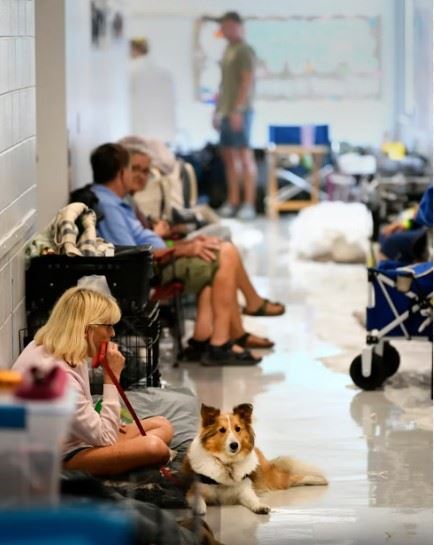 Evacuating and Shelter With a Pet
A crucial aspect of pet preparedness is planning and knowing evacuation routes and shelter procedures. This might mean identifying multiple evacuation routes and conducting timed evacuation drills to ensure speed and efficiency during a real-world emergency. Prior to an emergency, pet owners should identify pet-friendly hotels and shelters. Determining how to safely transport a pet is also vital to the animal’s safety. If needed, be sure to include a sturdy leash or carrier to the pet emergency kit. The following strategies can be used to reduce your pet's stress:
- Leave the carrier out in places your pet frequently visits
- Leave the carrier open
- Feed them treats near the carrier – you can even try putting a few treats inside the carrier
- Add a favorite blanket or small bed inside the carrier so it smells familiar
- Make note of where your pets hide, so you can easily find them in case you have to leave your house quickly.
Disaster organizations, such as the Red Cross, have specific protocols regarding sheltering pets. By understanding these regulations and identifying pet-friendly shelter locations in advance, pet owners can greatly reduce the stress associated with emergency pet care. Temporary and long-term options should also be considered.
Tips for Larger Animals or Livestock
- Ensure all animals have some form of identification.
- Evacuate animals earlier, whenever possible. Map out primary and secondary routes in advance.
- Make available vehicles and trailers needed for transporting and supporting each type of animal. Also make available experienced handlers and drivers.
- Ensure destinations have food, water, veterinary care and handling equipment.
- If evacuation is not possible, animal owners must decide whether to move large animals to a barn or turn them loose outside.
Stay Informed
- Pay attention to wireless emergency alerts for local alerts and warnings sent by state and local public safety officials.
- Listen to local officials when told to evacuate or shelter in place.
- Download the FEMA app and get weather alerts from the National Weather Service, for up to five different locations anywhere in the United States.
- Always bring pets indoors at the first sign or warning of a storm or disaster.
There may be situations when it's best to stay where you are and shelter-in-place whether at home, work, or anywhere else you frequently visit. Chemical, biological, or radiological contaminants may be released into the environment in such quantity and/or proximity to your neighborhood, place of employment, or school that it is safer to remain indoors rather than to evacuate. Such releases may be either accidental or intentional.
During a Shelter-in-Place Incident
- Listen to local radio and television stations for detailed information from emergency responders and follow instructions carefully. Instructions may differ depending on the HAZMAT involved and risk of exposure. Sometimes, it may be safer to shelter in your home; other times, it may be safer to evacuate.
- If instructed to stay indoors:
- Bring pets inside.
- Seek shelter in an internal room. Close and lock all exterior doors and windows. Close vents, fireplace dampers, and as many interior doors as possible. Seal the room with duct tape and plastic sheeting.
- Turn off air conditions and ventilation systems or set ventilation systems to 100 percent (100%) recirculation so that no outside air is drawn into the building.
- Seal gaps under and around the following areas with wet towels, plastic sheeting, duct tape, wax paper, and/or aluminum foil:
- Doorways and Windows
- Air Conditioning Units
- Bathroom and Kitchen Exhaust Fans
- Stove and Dryer Vents with Duct Tape and Plastic Sheeting
- Take shallow breaths through a cloth or towel if gas or vapors may have entered your location.
- Avoid eating or drinking any food or water that may be contaminated.
- If outside when the a shelter-in-place situation occurs:
- Quickly decide the fastest way to move upwind away from the contaminated area and find clean air.
- If in a car, keep the car windows and vents closed. Shut off the air conditioner or heater.
- Find the closest building to shelter-in-place.
For additional information regarding shelter-in-place procedures in response to various emergencies, please see the Shelter-in-Place Guidance brochure from the Federal Emergency Management Agency (FEMA).
Thunderstorms are common and can be dangerous. Severe thunderstorms are officially defined as storms that are capable of producing hail that is an inch or larger or wind gusts over 58 mph. Hail this size can damage property such as plants, roofs and vehicles. Wind this strong is able to break off large branches, knock over trees or cause structural damage to trees. Some severe thunderstorms can produce hail larger than softballs or winds over 100 mph, so please pay attention to the weather so you know when severe storms are possible. Thunderstorms also produce tornadoes and dangerous lightning; heavy rain can cause flash flooding. In most places, thunderstorms can occur year-round and at any hour.
Watch vs. Warning
Before a Thunderstorm
- Sign up for your community's emergency alert warning system.
- Create an emergency plan so that you and your family know what to do, where to go, and what you will need to protect yourselves from the effects of a thunderstorm.
- Identify sturdy buildings you can take shelter in close to where you live, work, study, and play.
- Cut down or trim trees that may be in danger of falling on your home.
- Consider buying surge protectors, lightning rods, or a lightning protection system to protect your home, appliances, and electronic devices.
During a Thunderstorm
- "When thunder roars, go indoors!" Move from outdoors into a building or car with a roof.
- Pay attention to alerts and warnings.
- Avoid using electronic devices connected to an electrical outlet.
- Avoid running water.
- "Turn around. Don't drown!" Do not drive through flooded roadways. Just six inches of fast-moving water can knock you down, and one foot of moving water can sweep your vehicle away.
After a Thunderstorm
- Pay attention to authorities and weather forecasts for information on whether it is safe to go outside and instructions regarding potential flash flooding.
- Watch for fallen power lines and trees. Report them immediately.
Severe Thunderstorm Watch vs. Severe Thunderstorm Warning
Hurricanes are among nature's most powerful and destructive phenomena. On average, 14 tropical storms, 7 of which become hurricanes form over the Atlantic Ocean, Caribbean Sea, or Gulf of America during the Atlantic hurricane season, which runs from June 1 to November 30 each year.
While hurricanes pose the greatest threat to life and property, tropical storms and depression also can be devastating. The primary hazards from tropical cyclones (which include tropical depressions, tropical storms, and hurricanes) are storm surge flooding, inland flooding from heavy rains, destructive winds, tornadoes, and high surf and rip currents.
Watch vs. Warning
Prepare for a Tropical Storm or Hurricane
- Know your risk. It is important to understand how rain, winds, water, or tornadoes can occur far inland from where a tropical storm or hurricane makes landfall.
- Create an Emergency Kit. Ensure that you have enough supplies for your household, including medications, disinfectant supplies, and pet supplies.
- Make an Emergency Plan. The plan should incorporate the unique needs of all family members, especially persons with disabilities, children, the elderly, and pets.
- Map out and drive your evacuation routes. If instructed to do so, evacuate immediately. Follow the instructions of local emergency managers and public officials. They will provide the latest recommendations based on the threats to your community and appropriate protective actions.
- Sign up for local emergency alerts and notifications via Alert Prince George's.
- Review and store important documents in a weather-proof container.
- Strengthen your home by de-cluttering gutters, clear drains, and secure outdoor furniture.
- Purchase backup charging devices to power electronics.
Stay Safe During a Hurricane
- Continue to stay informed by monitoring weather forecasts and emergency alerts.
- Determine how best to protect yourself from high winds and flooding.
- Take refuge in a designated storm shelter or an interior room for high winds.
- Go to the highest level of the building if you are trapped by flooding. Do not climb into a closed attic. You may become trapped by rising flood water.
- Do not walk, swim or drive through flood waters. "Turn Around. Don’t Drown!" Just six inches of fast-moving water can knock you down, and one foot of moving water can sweep your vehicle away.
After a Hurricane
- Pay attention to local officials for information and special instructions.
- Be careful during clean up. Wear protective clothing, use appropriate face coverings or masks if cleaning mold or other debris. People with asthma and other lung conditions and/or immune suppression should not enter buildings with indoor water leaks or mold growth that can be seen or smelled, even if these individuals are not allergic to mold. Children should not help with disaster cleanup work.
- Wear protective clothing and work with someone else.
- Do not touch electrical equipment if it is wet or if you are standing in water. If it is safe to do so, turn off electricity at the main breaker or fuse box to prevent electric shock.
- Do not wade in flood water, which can contain dangerous pathogens that cause illnesses. This water also can contain debris, chemicals, waste and wildlife. Underground or downed power lines also can electrically charge the water.
- Save phone calls for emergencies. Phone systems often are down or busy after a disaster. Use text messages or social media to communicate with family and friends.
- Document any property damage with photographs. Contact your insurance company for assistance.
A tornado is a violently rotating column of air in contact with the ground, which moves at speeds ranging from 50 – 200mph. It is only visible due to water droplets mixed with dust and debris. Contrary to popular belief, tornadoes do not leave the ground; the intensity changes, causing them to appear to “jump.” Tornadoes are categorized into three groups based on the Enhanced Fujita Scale.
The most common direction of a tornado to travel is from the southwest to the northeast, but tornadoes can form from any direction. Tornadoes are most likely to occur during the afternoon and evening from 3:00 PM – 9:00 PM from April – November. Since tornadoes are relatively spontaneous, the National Weather Service (NWS) and the DEM may not be able to issue timely shelter-in-place or evacuation notifications.
Watch vs. Warning
Prepare for a Tornado
- Know your area’s tornado risk. In the U.S., the Midwest and the Southeast have a greater risk for tornadoes.
- Know the signs of a tornado, including a rotating, funnel-shaped cloud, an approaching cloud of debris, or a loud roar like a freight train.
- Sign up for your community’s warning system. The Emergency Alert System (EAS) and NOAA Weather Radio also provide emergency alerts. If your community has sirens, then become familiar with the warning tone.
- Pay attention to weather reports. Meteorologists can predict when conditions might be right for a tornado.
- Identify and practice going to a safe shelter such as a safe room built using FEMA criteria or a storm shelter built to ICC 500 standards. The next best protection is a small, interior, windowless room or basement on the lowest level of a sturdy building.
- Plan for your pet. They are an important member of your family, so they need to be included in your family’s emergency plan.
- Prepare for long-term stay at home or sheltering in place by gathering emergency supplies, cleaning supplies, non-perishable foods, water, medical supplies and medication.
Stay Safe During a Tornado
- Immediately go to a safe location that you have identified.
- Pay attention to EAS, NOAA Weather Radio, or local alerting systems for current emergency information and instructions.
- Protect yourself by covering your head or neck with your arms and putting materials such as furniture and blankets around or on top of you.
- In a car or truck: There is no safe option when caught in a tornado in a car, just slightly less-dangerous ones.
- If the tornado is visible, far away, and the traffic is light, you may be able to drive out of its path by moving at right angles to the tornado.
- If you are caught by extreme winds or flying debris, park the car as quickly and safely as possible -- out of the traffic lanes.
- Stay in the car with the seat belt on. Put your head down below the windows; cover your head with your hands and a blanket, coat, or other cushion if possible.
- If you can safely get noticeably lower than the level of the roadway, leave your car and lie in that area, covering your head with your hands.
- Avoid seeking shelter under bridges, which can create deadly traffic hazards while offering little protection against flying debris.
After a Tornado
- Pay attention to EAS, NOAA Weather Radio, and local authorities for updated information.
- Stay clear of fallen power lines or broken utility lines.
- Contact your healthcare provider if you are sick and need medical attention. Wait for further care instructions and continue to shelter in place.
- Wear appropriate gear during clean-up such as thick-soled shoes, long pants, and work gloves, use appropriate face coverings or masks if cleaning mold or other debris.
Wildfire are unplanned fires that burn in natural areas like forests, grasslands, or prairies. These dangerous fires spread quickly and can devastate, not only wildlife and natural areas, but communities as well.
Before a Wildfire
- Recognize warnings and alerts, and pay attention to air quality alerts.
- Make an emergency plan.
- Review the plan with everyone in your household to ensure they understand what to do if they need to evacuate quickly.
- Be sure the plan includes what to do if at work, school, or anywhere you frequent.
- Review important documents.
- Keep insurance policies and personal documents up to date.
- Make copies of important documents and secure them in password-protected digital spaces or durable, waterproof storage containers.
- Strengthen your home.
- Use fire-resistant building materials to build, renovate, or make repairs.
- Find an outdoor water source with a hose that can reach any area of your property.
- Create a fire-resistant zone that is free of leave, debris, or flammable materials at least 30 feet from your home.
- Designate a room that can be closed off from outside air. Close all doors and windows. Set up a portable air cleaner to keep indoor pollution levels low when smoky conditions exist.
- Know your evacuation zone.
- You may have to evacuate quickly due to a wildfire. Learn your evacuation routes, practice with household, pets and identify where you will go.
- Follow the instructions from local authorities. They will provide the latest recommendations based on the threat to your community and appropriate safety measures.
- Gather supplies.
- Have enough supplies for your household, including a first aid kit, in your go bag or car trunk.
- Being prepared allows you to avoid unnecessary excursions and to address minor medical issues at home, alleviating the burden on urgent care centers and hospitals.
- Remember that not everyone can afford to respond by stocking up on necessities. For those who can afford it, making essential purchases and slowly building up supplies in advance will allow for longer time periods between shopping trips.
- Be cautious when carrying flammable or combustible household products that can cause fires or explosions if handled wrong, such as aerosols, cooking oils, rubbing alcohol and hand sanitizer
- If available, store an N95 mask to protect yourself from smoke inhalation.
- Keep your cell phone charged when wildfires could be in your area. Purchase backup charging devices to power electronics.
- Have enough supplies for your household, including a first aid kit, in your go bag or car trunk.
During a Wildfire
- Pay attention to emergency alerts and notifications for information and instructions.
- Evacuate immediately if authorities tell you to do so!
- Check with local authorities for the latest information about public shelters or check open locations on the FEMA app. You can also download the free Red Cross Emergency app for a list of open Red Cross shelters in your area.
- Consider making plans with friends or family to shelter with them where you may be safer and more comfortable.
- If trapped, call 9-1-1 and give your location, but be aware that emergency response could be delayed or impossible. Turn on lights to help rescuers find you.
- Use an N95 mask to protect yourself from smoke inhalation or limit your exposure to smoke by doing the following:
- Choose a room to close off from outside air and set up a portable air cleaner or filter to keep the air in this room clean even when it’s smoky in the rest of the building and outdoors.
- Use high efficiency filters in your central air conditioning system to capture fine particles from smoke. If your system has fresh air intake, set the system to “recirculate” mode and close the outdoor intake damper.
- If you are not ordered to evacuate but smoky conditions exist, stay inside in a safe location or go to a community building where smoke levels are lower.
- If you are sick and need medical attention, contact your healthcare provider for further care instructions and shelter in place, if possible.
After a Wildfire
- Do not return home until authorities say it is safe to do so.
- Avoid hot ash, charred trees, smoldering debris and live embers. The ground may contain heat pockets that can burn you or spark another fire.
- When cleaning, wear protective clothing – including a long-sleeved shirt, long pants, work gloves and sturdy thick-soled shoes – during clean-up efforts.
- Use a respirator to limit your exposure, and wet debris to minimize breathing dust particles. People with asthma, COPD and/or other lung conditions should take precautions in areas with poor air quality, as it can worsen symptoms.
- Document property damage with photographs. Conduct an inventory and contact your insurance company for assistance.
- Send text messages or use social media to reach out to family and friends. Phone systems are often busy following a disaster. Make calls only in emergencies.
For additional information and videos regarding wildfires, visit https://www.ready.gov/wildfires.
Winter storms create a higher risk of car accidents, hypothermia, frostbite, carbon monoxide poisoning, and heart attacks from overexertion. Winter storms, including blizzards can bring extreme cold, freezing rain, snow, ice, and high winds. A winter storm can last for a few hours or several days; cut off heat, power, and communication services, and put older adults, children, sick individuals, and pets at greater risk.
Winter Storm Watch vs. Winter Storm Warning
Winter Travel Safety
In 2022, according to the National Highway Traffic Safety Administration, there were 498 fatal traffic crashes and an estimated 32,213 injury crashes that occurred when snow/sleet conditions were present. In addition to annual maintenance, you can winterize your car in the following ways:
- Test your battery; battery power drops as the temperature drops.
- Check the tread of your tires and replace if less than 2/32 of an inch.
- Check tire pressure; like your battery, tire pressure is affected by temperature drops
- Replace your wiper blades, if needed.
- Add wiper fluid that is rated for –30 degrees Fahrenheit.
- Keep your gas tank at least half full to avoid frozen gas lines.
When operating your vehicle in winter conditions, remember to slow down. It’s harder to control or stop your vehicle on a slick or snow-covered surface. It is also important to increase your following distance enough so that you’ll have plenty of time to stop for vehicles ahead of you. Additional safe driving tips include:
- Avoid using cruise control in wintry conditions.
- Steer in the direction of a skid. When your wheels regain traction, you won’t have to overcorrect to stay in your lane.
- Accelerate and decelerate slowly.
- Increase following distances.
- If possible, avoid stopping when going uphill.
Finally, you never know when you will encounter winter weather or an emergency road closure. Preparing a winter car emergency kit is extremely helpful should you become stranded. A kit should include the following items:
- Jumper Cables
- Flares or Reflective Triangle
- Ice Scraper
- Car Cellphone Charger
- Blanket
- Map
- Sand or Cat Litter
Winter Activity Safety
According to the U.S. Consumer Product Safety Commission (CPSC), there were an estimated 124,700 winter sports-related injuries and 4,700 snow blower-related incidents. The most common injuries related to winter activities are sprains, strains, dislocations, and fractures.
Most incidents can be avoided by adhering to the following practical safety tips.
- Wear appropriate protective gear, including googles, helmet, gloves, and padding.
- Check that equipment is working properly prior to use.
- Maintain proper hydration.
- Be aware of the signs and symptoms of frostbite and hypothermia.
- Do some stretching and low-key exercises a few minutes prior to activity.
- Take frequent breaks when shoveling.
- If using a shovel to clear snow, lift with your legs, not your back.
- Do not try to clear the chute of a snow blower with your hand.
- Never leave a gas-powered snow blower running in an enclosed area as it can cause carbon monoxide poisoning.
Dressing for Winter Weather
Exposure to cold weather can cause frostbite and hypothermia, which can be life-threatening. Nearly 1,000 people die from hypothermia every year. Understanding how to protect the body from excessive exposure to cold conditions is crucial when working outside or participating in winter activities. The following guidelines can assist in reducing the risks associated with cold temperatures and low wind chills:
- Layering
- Use light-weight and comfortable fabrics that trap the air warmed by the body. This will allow moisture to be conducted away from the skin.
- Wicking
- The first layer for cold weather exposure should keep you warm and dry. The best materials include synthetic fibers, which dry quickly and “wick” wetness away from the skin effectively.
- Insulation
- Clothing should be comfortable, light-weight, durable, and windproof. The best insulators. such as wool and goose down will trap warm air while still allowing for ventilation. It is important to note that additional insulating layers may need to be added if the activity level tapers off.
- The Shell
- Outerwear should be appropriate for the activity. Coats and pants should allow for ventilation while blocking wind and rain. The material should reduce heat loss but aid in keeping someone dry and comfortable.
- Covering Your Head, Hands, And Feet
- Head
- Covering the head is critical as body heat escape more readily than the hands or feet.
- Hands
- In order to preserve heat to vital organs, the body limits blood flow to the extremities. For this reason, hands and feet are the first things to get cold. Wear gloves that are breathable and waterproof.
- Feet
- Footwear, including socks, should be durable, waterproof, and breathable. The tread should provide good traction, designed to grip the snow and ice.
- Head
Indoor Heating Safety
According to the National Fire Protection Agency (NFPA), space heaters account for approximately 1/3 of home heating fires and 80% of home heating fire deaths annually. Below is a list of safety precautions that should be used with heating equipment:
- Keep anything that can burn at least 3 feet away from any heating equipment.
- Never use an oven to heat your home.
- Clean and inspect heating equipment annually.
- Turn off portable heaters and extinguish fireplaces before going to bed or leaving the house.
- Test smoke alarms monthly.
During the winter months, carbon monoxide (CO) exposures and poisonings occur more often due to the use of furnaces and heaters. CO is often referred to as the “silent killer” as it has no smell, taste, or color. Protect yourself and family by practicing indoor heating safety, understanding the symptoms of carbon monoxide poisoning, and installing CO detectors. Symptoms of CO poisoning include:
- Headache
- Dizziness
- Nausea
- Vomiting
- Mild Confusion
- Shortness of Breath
If you are experiencing symptoms of CO exposure or poisoning, seek medical care immediately. Healthcare professionals can check CO levels in your blood and treat you with oxygen. If you are unsure about exposure to CO, contact poison control 24 hours every day at 800-222-1222.